
How to Check Gas Leaks at Home Safely
Learn how to check gas leaks at home safely, what warning signs to watch for, when to leave immediately, and when to call a licensed pro.
A gas leak is not the kind of problem to monitor for a few days and hope it goes away. If you are searching for how to check gas leaks, the first priority is safety - not troubleshooting for the sake of troubleshooting. Homeowners in Albany-area homes often notice a sulfur smell, hear a faint hissing sound, or see a gas bill climb without a clear reason. Those are all signs to take seriously.
Natural gas systems are reliable when they are installed and repaired correctly, but when something is off, the right move is to stay calm and act fast. There are a few basic ways to look for warning signs, but there is also a clear point where you stop checking and call the utility company or a licensed plumber for immediate help.
How to Check Gas Leaks Without Taking Risks
The safest way to approach a suspected leak is to start with observation, not experimentation. You do not want to create a spark, disturb a damaged fitting, or stay inside longer than necessary if the leak appears significant.
Start with smell. Utility companies add a sulfur-like odorant to natural gas so leaks are easier to detect. Many homeowners describe it as rotten eggs. If that smell is strong or suddenly noticeable near a stove, water heater, furnace, basement ceiling, or gas meter area, treat it as a real hazard.
Next, listen carefully. A hissing or whistling sound near a gas appliance, exposed gas pipe, shutoff valve, or connector can point to gas escaping under pressure. Not every leak makes noise, but if you hear it, that is a serious warning sign.
You can also look for visual clues. Outside, a damaged underground gas line may cause bubbling in standing water or patches of dead or discolored vegetation. Inside, dust blowing oddly near a fitting or movement around a connection can sometimes suggest escaping gas. These signs are less common than smell, but they matter.
If the odor is strong, do not keep checking. Leave the home, keep others away, and call the gas utility and emergency services if needed from outside.
The Soap Solution Test for Small, Accessible Leaks
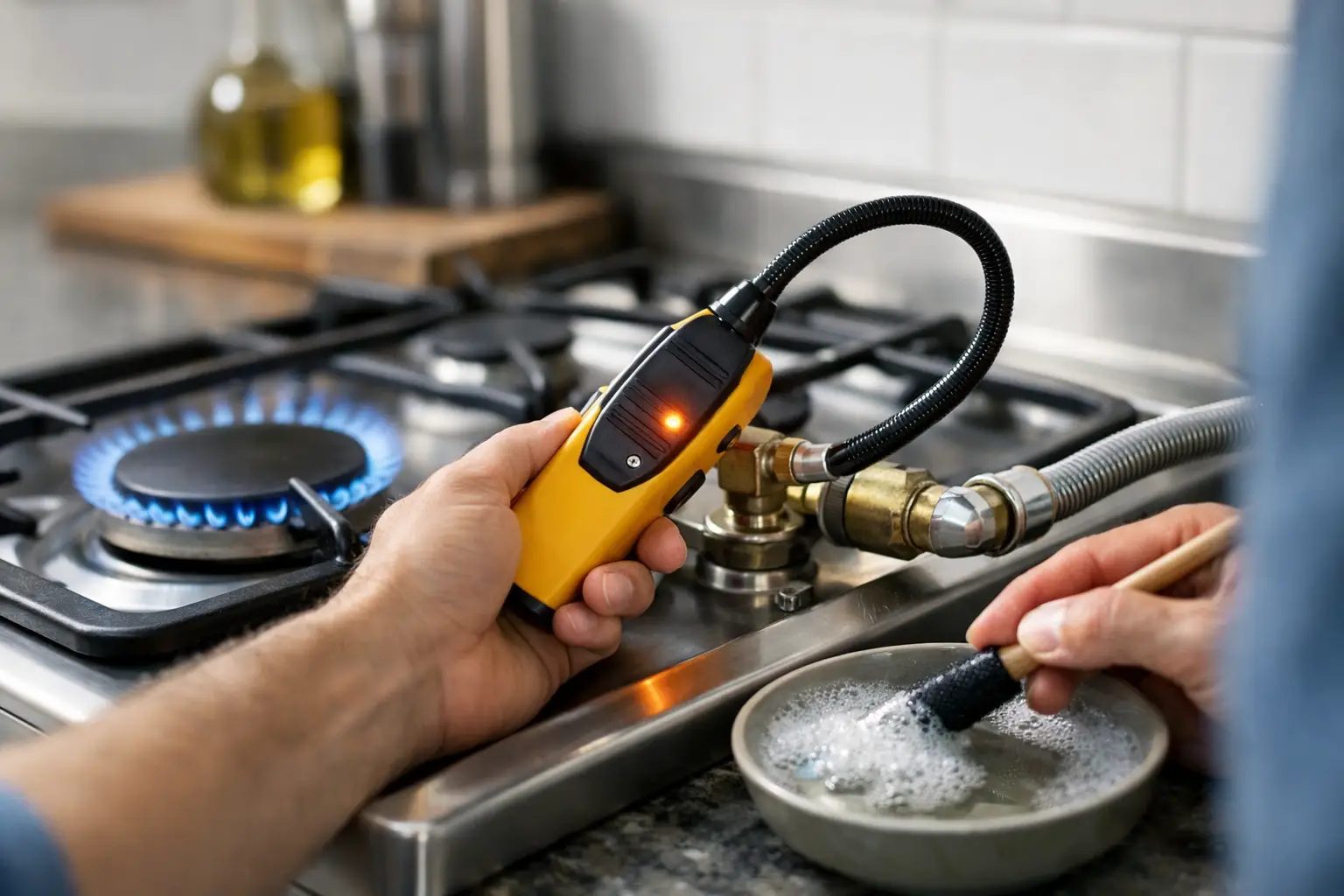
If there is no heavy odor, no obvious emergency, and you are checking an exposed connection that is easy to access, a soap solution test is the standard homeowner-safe method. This is typically used on visible pipe joints or appliance connectors, not hidden piping inside walls or underground lines.
Mix dish soap with water in a spray bottle or bowl. Apply the solution to the suspected connection point. If gas is escaping, the soap will form growing bubbles at the leak location. Small surface foam is not enough by itself - what you are looking for is active bubbling that continues or expands.
This method can help with a suspected minor leak around a fitting, but it has limits. It only works where you can clearly reach and see the pipe or connector. It also does not tell you why the leak is happening, whether the pipe is corroded, or whether the repair will require code upgrades or replacement parts.
If you see bubbling, stop there. Do not try multiple rounds of tightening unless you know exactly what type of connection you are working on. Gas piping repairs are not a trial-and-error job.
What Not to Do When You Suspect a Gas Leak
A lot of homeowners make a bad situation worse by trying to confirm the problem the wrong way. Never use a lighter, match, candle, or any flame to check for a leak. That sounds obvious, but it still happens.
You should also avoid turning lights or appliances on and off if you smell gas strongly indoors. A simple switch can create ignition. Do not use garage door openers, thermostats, or electrical devices if the leak appears serious. Leave first, then make calls from outside.
Do not assume the smell is coming from the sewer, a drain, or a nearby product without checking further. Sewer gas and natural gas can sometimes be confused by homeowners, especially near basements, utility rooms, or older piping. The difference matters because the response is different.
And do not rely on your nose alone if the concern is ongoing but faint. Some people do not detect gas odor well, and odor fade can occur under certain conditions. If something seems off, it is worth having it properly tested.
Common Places Gas Leaks Show Up
Gas leaks often happen at predictable points in a residential system. Appliance connectors are one common source, especially behind stoves and dryers where movement or age can weaken fittings over time. Water heaters and furnaces are another frequent trouble spot because they involve multiple connections, shutoff valves, and venting components in one area.
Gas shutoff valves can also develop leaks around packing nuts or threaded joints. In older homes, corrosion on black iron gas pipe is another concern, especially in basements where humidity has been an issue for years. Outdoor meter connections and transitions between indoor and outdoor piping can be vulnerable too.
That is why diagnosis matters. The visible fitting may not be the full problem. A homeowner may spot bubbling at one joint, while the underlying issue is excess movement, poor support, corrosion, or a previous improper repair.
When to Leave Immediately Instead of Checking Further
There is a big difference between a faint suspicion and an active gas leak emergency. If the odor is strong, if multiple people smell it, if you hear gas escaping, or if anyone in the home feels dizzy, nauseated, or lightheaded, do not stay inside to investigate.
Leave the building right away. Do not stop to open windows if the odor is heavy. Do not try to locate the exact source. Once outside and away from the building, contact the gas utility and emergency responders as appropriate. After the area is made safe, a licensed plumber can handle repair and code-compliant restoration of the gas line or appliance connection.
For homeowners, that is the line between caution and overconfidence. Basic awareness is helpful. Extended indoor troubleshooting is not.
Why Professional Leak Detection Is Different
A licensed plumber does more than confirm that a leak exists. The real value is identifying where it is, why it started, what code requirements apply, and what repair approach makes sense for the home.
Professional testing may include pressure testing, electronic gas detection equipment, isolation of appliance branches, and inspection of shutoffs, sediment traps, connectors, and venting conditions. In some cases, the issue is a simple fitting repair. In others, the safer fix is replacing a section of pipe, correcting an improper connection, or addressing aging gas components before another leak develops.
That matters in older homes around Albany, Colonie, Troy, Delmar, and East Greenbush, where systems may have been modified over time by different contractors or homeowners. A quick patch may not be enough if the installation itself is not up to standard.
If You Need to Shut Off the Gas
Some homeowners ask whether they should turn off the gas supply themselves. The answer depends on the situation, your access to the shutoff, and whether doing so puts you in more danger. If the leak is minor and the shutoff is easy to reach without moving through a gas-heavy area, shutting off the local appliance valve may help. But if there is a strong odor or you need to move deeper into the home to reach a valve, leave instead.
Main gas shutoff operation should be handled carefully. Once the gas is turned off, appliance relighting and system restart may need to be done correctly and safely. If you are not sure, do not force it. This is one of those cases where avoiding guesswork protects your home.
The Practical Rule for Homeowners
If you want the simplest answer to how to check gas leaks, it is this: use your senses first, use a soap solution only on a visible and safely accessible connection, and stop the moment the situation seems more than minor. That is the practical limit for most homeowners.
Gas issues are not the place for internet fixes, repeated tightening, or assumptions. A diagnosis-first approach saves time and reduces risk. If a gas line, shutoff, or appliance connector in your home may be leaking, getting it checked properly is the fastest way to protect the house and the people in it.
For a homeowner, the smartest move is not proving you can find the leak on your own. It is knowing when a problem has crossed into professional territory and acting before it gets worse.