
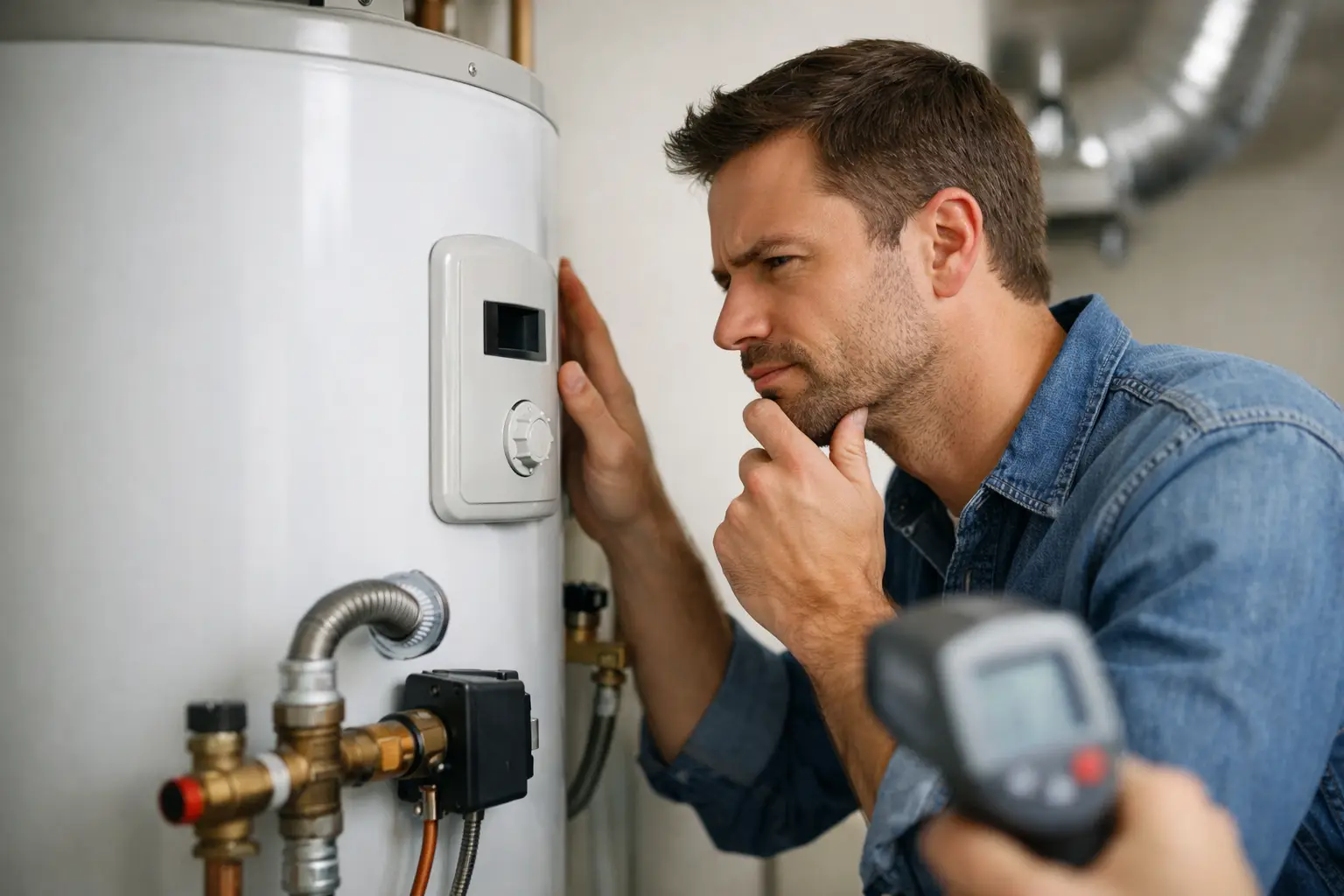
Water Heater Not Heating? Start Here
Water heater not heating? Learn the most common causes, what to check safely, and when to call for fast, code-compliant repair.
If your water heater not heating problem showed up during the morning shower, you are probably not looking for theory. You want to know what failed, what you can safely check, and whether this is a quick fix or a same-day repair call.
No hot water can come from a simple reset, a tripped breaker, a pilot issue, a failed heating element, a bad thermostat, sediment buildup, or a tank that has simply reached the end of its service life. The right next step depends on whether you have an electric, gas, or tankless unit and whether the problem is total loss of hot water or just water that never gets hot enough.
Why a water heater is not heating
Most residential water heaters fail in a few predictable ways. The problem is that those failures can look the same from the homeowner side. You turn on the tap and get lukewarm water, cold water, or hot water that runs out far too fast.
With an electric tank water heater, the usual culprits are a tripped breaker, a reset switch that has popped, a failed upper or lower heating element, or a thermostat that is no longer regulating temperature correctly. Electric units are straightforward in design, but diagnosis still matters because replacing the wrong part wastes time and money.
With a gas water heater, the issue is often tied to the pilot light, thermocouple, gas control valve, burner assembly, or venting. If the pilot will not stay lit, that points in a different direction than a tank that lights but does not recover fast enough. Gas appliances also bring safety concerns, so guessing is not a good plan.
Tankless systems add another layer. A tankless water heater not heating may be dealing with scale buildup, ignition failure, sensor issues, low flow, or a venting problem. These units are efficient, but they are less forgiving when maintenance has been skipped.
What you can check before calling
A few checks are reasonable for a homeowner. The key is staying on the safe side and not turning a repair into a bigger problem.
Start with the obvious. Make sure the issue is affecting the whole house and not just one fixture. If only one shower or sink is cold, the water heater may be fine and the problem may be with that fixture's valve or cartridge.
If you have an electric unit, check the electrical panel for a tripped breaker. Do not just glance at it. A water heater breaker can look on while sitting in a tripped middle position. Reset it fully once. If it trips again, stop there. Repeated tripping points to an electrical fault, and that needs proper diagnosis.
If your electric heater has a reset button behind an access panel, you can press it once after shutting off power to the unit. If the reset trips again, there is usually an underlying thermostat or element problem. That is not something to keep resetting.
If you have a gas unit, look to see whether the pilot is lit if your model has one. Follow the manufacturer's lighting instructions exactly. If you smell gas, do not attempt relighting. Leave the area and call for service right away.
Also check the thermostat setting. It sounds basic, but accidental adjustments happen. If the setting is too low, the water may feel like the heater is failing when it is really just under-set.
Signs the problem is bigger than a quick fix
Some symptoms tell you this is not just a reset-and-go situation. If the tank is leaking, if the breaker keeps tripping, if there is a burning smell, if the pilot will not stay lit, or if the unit is making loud popping and rumbling noises, it is time for a real service call.
Age matters too. A standard tank water heater often lasts around 8 to 12 years, depending on water quality, maintenance, and usage. If your older unit has inconsistent heating, visible corrosion, or water around the base, repair may not be the best use of your money.
There is also a difference between no hot water and not enough hot water. If the tank starts hot but runs out quickly, sediment buildup or a failed lower element may be the issue. If there is never any hot water at all, that points more toward power, gas supply, ignition, control, or an upper element problem.
Electric water heater not heating
Electric water heaters are common in many homes, and the failure pattern is usually manageable once the cause is identified. The challenge is that several different parts can create the same symptom.
A failed upper heating element can leave you with little or no hot water. A failed lower element often produces some hot water, but not enough for normal household use. Bad thermostats can overheat, underheat, or stop calling for heat entirely. Wiring problems can also interrupt operation, especially on older units or units that have had prior repair work done poorly.
This is where diagnosis-first service matters. Swapping parts without testing voltage, continuity, and thermostat response can turn a simple repair into multiple visits. If an element burned out because of a deeper thermostat issue, replacing only the element may not hold.
Gas water heater not heating
Gas units need correct ignition, clean burner operation, proper gas flow, and safe venting. If any of those are off, heating performance drops fast.
A pilot that will not stay lit often points to a thermocouple or flame sensing issue. A dirty burner can reduce heat transfer and slow recovery. A bad gas control valve can stop the unit from heating at all. Venting problems can also affect safe operation and need to be handled carefully.
Gas water heater repairs are not a place for trial and error. If there is any concern about combustion, venting, or gas supply, the right move is a licensed plumber with gas line experience who can inspect the system safely and make code-compliant repairs.
When sediment is the real problem
Albany-area homeowners sometimes deal with mineral buildup that settles in the bottom of the tank. Over time, that sediment acts like insulation between the burner or elements and the water. The heater works harder, recovery slows down, energy use climbs, and you may hear banging or popping from the tank.
In some cases, flushing the tank helps. In others, especially with an older neglected unit, a flush may not fully restore performance. If heavy sediment has already damaged an element or stressed the tank, you may be looking at repair or replacement instead of maintenance.
This is one of those it-depends situations. A newer tank with mild buildup may respond well. An older tank that has not been serviced in years may be telling you it is near the end.
Repair or replace?
Homeowners usually want a straight answer here, and the honest one is that it depends on the age of the unit, the exact failed part, the condition of the tank, and the total repair cost.
If the water heater is fairly new and the issue is an element, thermostat, thermocouple, or pilot-related component, repair often makes sense. If the tank itself is leaking, heavily corroded, or nearing the end of its expected life, replacement is usually the smarter call.
A good service process should not push you either way before diagnosis. It should identify the failure, explain the scope, and tell you whether a repair is likely to hold or whether you are putting money into a unit that is already on borrowed time.
What to expect from a professional diagnosis
When a plumber responds to a no-hot-water call, the first job is not selling equipment. It is narrowing down the cause quickly and safely. That means confirming power or gas supply, checking controls, testing components, inspecting for leaks or corrosion, and looking at venting and code issues where applicable.
That process matters because water heater symptoms overlap. A heater that seems dead could have a simple reset issue. Another with the same symptom could have a failed control, a compromised wiring connection, or a tank problem that makes repair a bad bet.
For homeowners in Albany, Colonie, Troy, Delmar, and East Greenbush, clear communication matters almost as much as the repair itself. You should know what failed, what the fix involves, whether the work is safe to perform immediately, and whether permits or replacement upgrades are needed. That is the standard Trinity Plumbing & Drains aims for on water heater service calls.
Don’t wait too long on a water heater not heating
A water heater not heating is easy to put off for a day or two if you can tolerate a lukewarm shower. The risk is that some failures get worse fast. Electrical faults can trip repeatedly. Small leaks can turn into tank failure. Burner or venting issues can create safety concerns. What starts as an inconvenience can become a bigger plumbing problem.
If you have checked the basics and still have no reliable hot water, the safest next step is professional diagnosis. Fast answers, clean workmanship, and code-compliant repair beat guesswork every time - especially when the hot water is not coming back on its own.