
What Counts as a Plumbing Emergency?
Learn what counts as a plumbing emergency, when to call right away, and which problems can wait for scheduled service without risking more damage.
A pipe bursts at 10 p.m., the basement drain starts backing up, or you smell gas near a water heater line. In moments like that, most homeowners are asking the same question: what counts as a plumbing emergency, and what can safely wait until morning? The answer comes down to risk - risk to your home, your health, and your safety.
If a plumbing problem is actively causing damage, creates a sanitation hazard, cuts off an essential part of your home, or involves gas, it should be treated as an emergency. If it is inconvenient but stable, it may be better handled as a standard service call. Knowing the difference helps you act fast when it matters and avoid letting a serious problem get worse overnight.
What counts as a plumbing emergency?
A plumbing emergency is not just any annoying plumbing issue. It is a problem that needs immediate professional attention because waiting can lead to structural damage, contamination, unsafe conditions, or total loss of a critical plumbing function.
In most homes, that means a burst pipe, major leak that cannot be contained, sewer backup, no access to working toilets in the house, sump pump failure during active water intrusion, no water to the home, or any suspected gas line problem. These are situations where delay usually increases the repair scope and the cost.
On the other hand, a dripping faucet, a slow drain in one sink, or a toilet that still works but runs occasionally is usually not an emergency. Those issues should still be repaired, but they do not usually require after-hours dispatch unless another condition raises the risk.
The quickest way to tell if it is urgent
A practical test is to ask three questions. Is water actively escaping where it should not be? Is waste or sewage coming back into the home? Is there any chance of a fire, explosion, contamination, or flooding? If the answer is yes to any of those, call right away.
There is also a fourth question that matters in real homes: can you safely control the problem yourself until business hours? If you can shut off one fixture, place a bucket, and the issue remains stable, it may wait. If you cannot stop the damage or the problem affects the whole house, it is emergency territory.
Plumbing problems that are usually emergencies
Burst pipes and major leaks
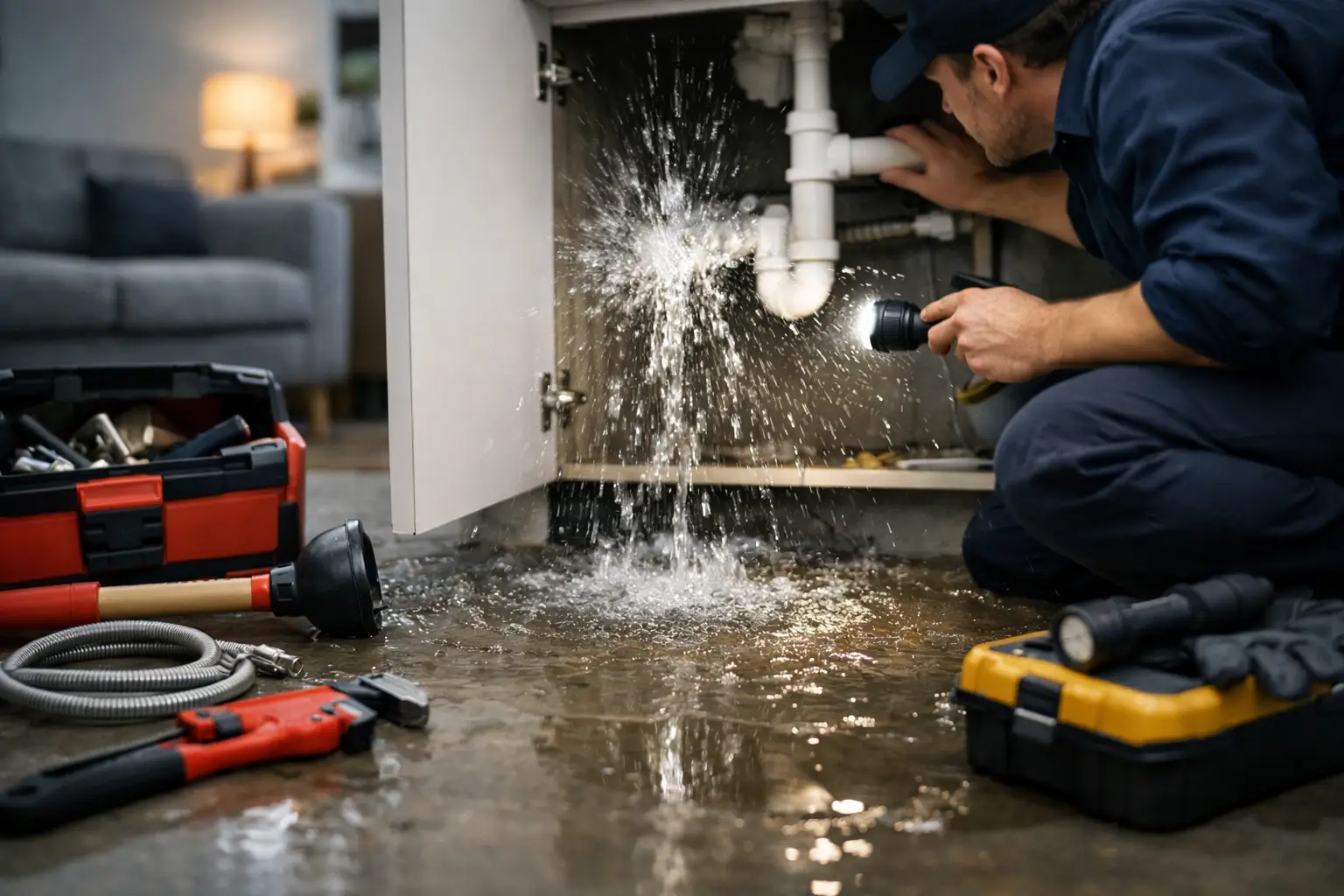
A burst pipe is one of the clearest examples of what counts as a plumbing emergency. Water can move fast through walls, ceilings, floors, insulation, and finished basements. Even a smaller supply line break under a sink can damage cabinets, drywall, and flooring within a short time.
If you see active spraying, pooling water, or water coming through a ceiling, shut off the water immediately if you can do so safely. Then call for emergency service. This is not the time to wait and see if it slows down.
Sewer backups
If sewage is coming up through a floor drain, shower, tub, or toilet, treat it as an emergency. This is not just a plumbing issue. It is a health hazard. Wastewater can contaminate surfaces, create strong odors, and make parts of the home unsafe to use.
A single clogged toilet may not be a sewer emergency if it is isolated and the rest of the house is draining normally. But when multiple fixtures are affected, or wastewater appears at the lowest drain in the home, that points to a larger drain or sewer line issue that needs fast diagnosis.
No water in the house
If the home has no water at all, that can be an emergency, especially if the loss is sudden and not related to a municipal outage. The cause could be a major leak, a failed main line, frozen piping, or another system failure.
For households with children, older adults, medical needs, or only one bathroom, no water becomes urgent very quickly. Basic sanitation, cooking, and normal use are affected right away.
No working toilets
One clogged toilet in a two-bathroom home is frustrating. One clogged toilet in a one-bathroom home is often an emergency. Context matters here.
This is where some homeowners get tripped up. The same plumbing problem can be routine in one house and urgent in another. If the home has no usable toilet, call for immediate help.
Sump pump failure during heavy rain or active flooding
A sump pump that stops working on a dry day may be an urgent repair, but not always an after-hours emergency. A sump pump that fails during a storm, while groundwater is rising or water is entering the basement, is a different situation.
At that point, the risk is direct water damage to the basement, stored belongings, electrical systems, and finished space. Fast response matters because once flooding starts, cleanup and restoration costs rise quickly.
Water heater leaks or dangerous failures
No hot water is not always a true plumbing emergency, though it can be urgent for some households. But a water heater that is leaking from the tank, making alarming noises, or showing signs of pressure-related failure should be addressed right away.
A leaking tank can let go suddenly. If you see water collecting around the unit, shut off power or gas to the heater if you know how to do it safely, and shut off the water supply. Then call a licensed plumber.
Gas line issues
If you smell gas, hear hissing near a gas appliance or line, or suspect a damaged gas connection, leave the area and call immediately. This is an emergency. Do not try to troubleshoot it yourself.
Gas line work is not a guess-and-check service. It requires trained diagnosis, proper safety procedure, and code-compliant repair.
Problems that may feel urgent but can often wait
Slow drains
A sink, tub, or shower draining slowly is a sign that service is needed, but it is usually not an emergency unless sewage is backing up or multiple drains are failing at once. A slow drain can often be scheduled during normal business hours.
Dripping faucets and minor fixture leaks
A dripping faucet wastes water and should be fixed, but it is rarely an emergency. The same goes for a small leak under a sink that can be contained with a bucket and a shutoff valve until a plumber arrives the next day.
One fixture not working properly
If one toilet is weakly flushing but another works, or one sink is clogged while others drain normally, the issue is usually localized. That matters because isolated problems are less likely to cause immediate system-wide damage.
It depends: when a non-emergency becomes an emergency
This is where good judgment matters. A small leak under a kitchen sink may not sound urgent, but if it is soaking a hardwood floor, dripping into a finished ceiling below, or you cannot shut it off, it needs immediate attention.
A clogged drain may sound minor, but if every flush causes water to rise in the tub, that points to a main drain blockage. No hot water may be a routine repair for some homes, but for a household with a newborn, an older adult, or a medical need, it can justify faster service.
The issue is not just the plumbing symptom. It is the consequence of waiting.
What to do before the plumber arrives
If you are dealing with an urgent plumbing issue, the first step is to limit damage without taking unnecessary risks. Shut off the main water valve if there is active leaking. If the problem is isolated to one fixture and you know where the local shutoff is, use that instead.
Do not keep running water into a backed-up drain. Do not use chemical drain cleaners before an emergency visit, especially if there may be a sewer or main line problem. If sewage is involved, keep people and pets away from the affected area.
For water heater or gas-related concerns, only shut off the unit if you know how to do it safely. If you smell gas, leave the home and make the call from outside.
Why correct diagnosis matters in an emergency
When homeowners are stressed, it is tempting to focus on the visible symptom only. But emergency plumbing service is not just about showing up fast. It has to be diagnosed correctly.
A basement backup might be a main sewer blockage, not a floor drain issue. Repeated clogs could point to a larger drain line problem. Water around a water heater may come from a valve, a supply connection, or a failed tank. The right repair depends on finding the actual source, not just treating what is easiest to see.
That is why homeowners in the Albany area often want a plumber who can respond quickly and work through the problem in a clean, organized, code-compliant way. Trinity Plumbing & Drains approaches emergency calls with that diagnosis-first mindset, because speed matters, but guessing costs more.
How homeowners should think about what counts as a plumbing emergency
If the problem threatens the house, the people in it, or a critical plumbing function, treat it seriously. If it can be isolated, contained, and safely managed until regular service hours, it may not need an emergency visit.
The right call is usually the one that prevents the next layer of damage. When you are unsure, think less about how annoying the problem is and more about what happens if it continues for the next eight hours. That simple test will steer you in the right direction - and when it will not, a quick call to a qualified plumber is better than waiting and hoping for the best.